Meibomian glands: understanding their role to better treat dry eye symptoms
The Meibomian glands play a key role in maintaining tear film balance and preventing dry eye, yet their dysfunction remains poorly understood.
Understanding the function of the Meibomian glands is essential to better manage dry eye symptoms and restore lasting visual comfort.
In this COP9 article, discover how the Meibomian glands work and why their proper function is essential for maintaining eye health.
What are the Meibomian glands?
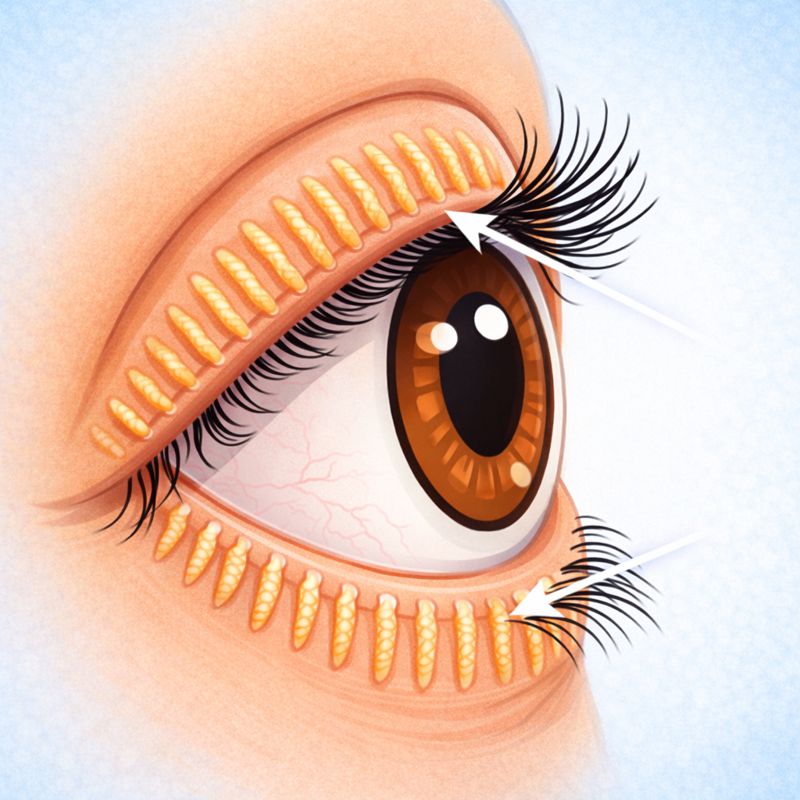
The Meibomian glands are anatomical structures located within the eyelids, specifically in the tarsal plates of both the upper and lower eyelids.
These glands play a crucial role in eye health, as they secrete a lipid-based oil (meibum) that forms the protective outer layer of the tear film covering the surface of the eye.
This tear film is essential for maintaining ocular surface hydration and preventing dry eye symptoms, a common condition that can lead to various ocular complications.
What is the role of the Meibomian glands in ocular health?
The lipid secretion produced by the Meibomian glands helps reduce tear evaporation, which is particularly important because the tear film also contains an aqueous component produced by the lacrimal glands.
These two layers work together to ensure that the ocular surface remains properly lubricated.
With each blink, the lipid layer is evenly spread across the eye, providing continuous lubrication and protecting the epithelium from external aggressors.
A balanced tear film is essential to prevent premature evaporation that can expose the cornea.
What happens when the Meibomian glands malfunction?
When the Meibomian glands do not function properly, tear film instability can occur, leading to pronounced dry eye symptoms.
Patients often report persistent eye irritation, pain, a burning sensation, and even a redness of the eyelids.
Visual discomfort may fluctuate throughout the day, sometimes making screen use or driving difficult.
What causes obstruction of the Meibomian glands?
Blockage of the gland openings is commonly observed in people suffering from blepharitis or other inflammatory conditions.
In addition to physiological causes, certain environmental factors (such as pollution, air conditioning, and wind) can worsen tear evaporation.
Systemic conditions such as Sjögren’s syndrome or rosacea (often associated with severe dry eye syndromes) may also alter the quality of the meibum.
This results in lipid deficiency and, consequently, significant instability of the tear film that protects the eye.
The importance of drainage: lacrimal ducts and tear drainage system
To fully understand ocular balance, tear drainage must also be considered.
After hydrating the eye, tears are normally drained through the lacrimal ducts.
If the lacrimal drainage system is obstructed or if tear quality is poor, a vicious cycle of inflammation may develop.
An ophthalmologist can determine whether the issue is related to excessive tear production (reflex tearing) or impaired drainage of the lacrimal ducts.
Meibomian glands: which treatments can relieve symptoms?
To address these issues and relieve symptoms, specialists often recommend the use of artificial tears or lubricating eye drops.
These ophthalmic solutions, sometimes enriched with vitamin A to promote corneal healing, help restore the protective tear film barrier.
Common treatment options for lasting relief include:
Eyelid hygiene: Application of warm compresses to help unblock the Meibomian gland ducts and liquefy thickened secretions.
Tear substitutes: Use of lubricating agents in gel or ophthalmic solution form.
Punctal plugs: In more severe cases, temporary plugs may be used to block tear drainage and retain natural tears on the ocular surface.
Surgical intervention: Rarely required, but may be considered to correct eyelid abnormalities that interfere with proper blinking.
In conclusion
In summary, the Meibomian glands play a vital role in ocular health by contributing to the formation of the tear film, which protects and lubricates the surface of the eye.
Proper function of the Meibomian glands is essential to prevent dry eye symptoms and conjunctival inflammation, and to maintain physiological hydration of the corneal epithelium.
If problems arise, we recommend consulting an ophthalmologist for an accurate diagnosis and appropriate treatment.
Nous utilisons des cookies pour vous garantir la meilleure expérience sur notre site web. Si vous continuez à utiliser ce site, nous supposerons que vous en êtes satisfait.