
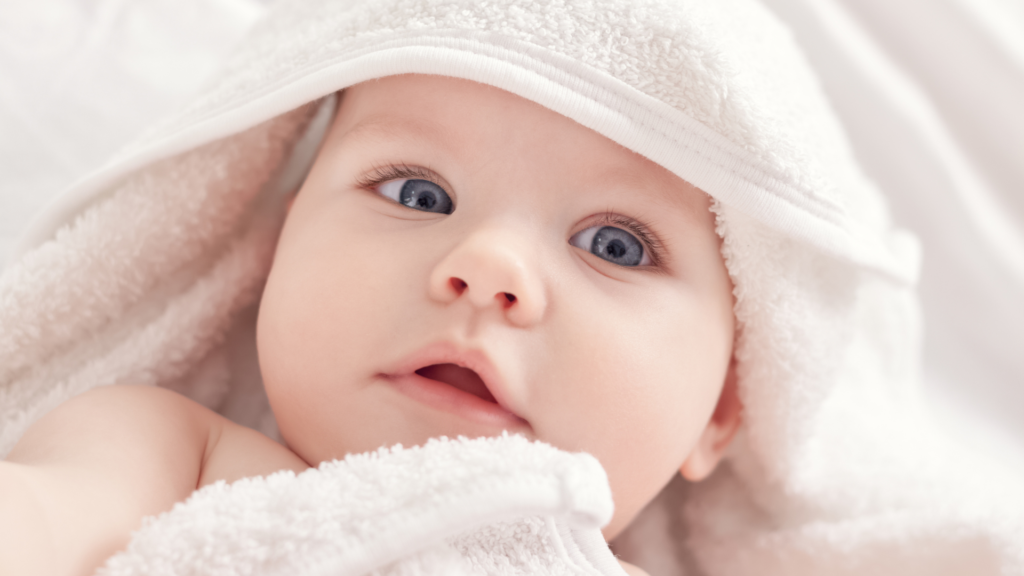
The question of predicting a baby’s eye color often intrigues parents. Is it possible at birth or even before?
In an article published by Femme Actuelle, journalist Esther Buitekant interviewed Dr Stéphanie Zwillinger to shed light on this topic. If you would like to learn more, we invite you to read the full article on the Femme Actuelle website.
Can genetics predict a baby’s eye color?
Genetics plays a major role when trying to predict a child’s eye color.
Eye color mainly depends on the amount of melanin present in the iris. The higher the melanin level, the darker the eyes; conversely, a lower amount results in blue or green eyes.
Genes inherited from the parents therefore strongly influence eye color. Brown eyes are generally dominant, while blue or green eyes are considered recessive.
However, even with these genetic rules, predicting eye color remains an estimation, as genetic combinations can lead to unexpected results.
Why is it difficult to predict a baby’s eye color with certainty?
Although genetics provides useful clues, accurately predicting eye color remains challenging.
At birth, many babies have blue-gray eyes because the iris initially contains very little melanin.
Over the following months, iris pigmentation gradually develops.
Eye color may therefore change during the first year of life, as melanin production stabilizes.
In reality, multiple genes are involved in this process, which explains why predicting eye color is never entirely reliable.
Conclusion
Genetics can offer some indications, but predict a baby’s eye color remains uncertain during the first months of life.
To explore Dr Stéphanie Zwillinger’s full analysis, we invite you to read the original article published on Femme Actuelle.